Front lever progression: 6 levels from the tuck hang to the full front lever
The front lever progression on the bar: tuck hang, tuck front lever, advanced tuck, straddle, half-lay, full front lever. Six-second hold targets at every rung and why skipping one costs your elbows.
- 6 rungs
- Levels 0–8
- Hold
- Horizontal pull
The front lever is the pulling skill: hanging under the bar with the body horizontal and the arms straight, held by the lats, the shoulders and a trunk that refuses to fold. It is reached by shortening the lever and lengthening it rung by rung. The tuck hang teaches you to hold the shoulders back and down under the bar. The tuck front lever lifts the hips to the bar's height with the knees in. The advanced tuck opens the hips; the straddle opens the legs; the half-lay straightens one leg; the full front lever straightens both.
Every rung is a straight-arm hold, which means every rung loads the elbows and shoulders through tendons that adapt slowly. This is the ladder where the six-second rule earns its keep, and where the tendon article is required reading. Rows and pull-ups, trained alongside, build the pulling strength the lever draws on; the front lever pull-up ladder adds movement once the holds are owned.
A hold counts when the arms are locked, the hips are at the bar's height, and the line from shoulders to the rung's leg position is level, not sagging, for six seconds.
The rungs
-
Level0
Tuck hang from the bar
Pass: a solid 6-second hold. Needs a pull-up bar.
-
Level4
Tuck front lever
Pass: a solid 6-second hold. Needs a pull-up bar.
-
Level5
Advanced tuck front lever
Pass: a solid 6-second hold. Needs a pull-up bar.
-
Level6
Straddle front lever
Pass: a solid 6-second hold. Needs a pull-up bar.
-
Level7
Half-lay / one-leg front lever
Pass: a solid 6-second hold. Needs a pull-up bar.
-
Level8
Full front lever
Pass: a solid 6-second hold. Needs a pull-up bar.
How Huplito uses this ladder
You never pick a rung yourself. The questions at the start and the calibration session place you on the hardest rung you can own, and the plan writes that rung into your sessions with sets, targets and rests. Holds are counted in seconds and converted to progress at roughly two seconds per rep. Flag pain at shoulder, elbow or lower back and the ladder is swapped out until it settles.
Frequently asked questions
How long does the front lever take?
From a solid tuck, most consistent trainees reach the advanced tuck in a few months and the straddle within a year. The full lever is an intermediate-to-advanced skill that commonly takes one to three years of patient climbing. Bodyweight, arm length and pulling background move the number a lot.
Do I need rings or a bar?
A bar. Rings work too and are slightly harder because they add instability. A doorway pull-up bar is enough for every rung.
How do I know when to move up the front Lever ladder?
When you own the current rung: a solid six-second hold with clean form. A shaky longer hold does not count; six seconds that look the same do.
What equipment does the front Lever ladder need?
A pull-up bar, depending on the rung. The first rungs need a pull-up bar.
Can I skip a rung?
Sometimes you can, and usually you shouldn't. Muscles adapt in weeks; tendons and joints take months. The rung you skip is the one your elbows wanted. Huplito makes you pass the bar rather than letting you jump.
Read the rules behind it

When to move to the next calisthenics progression (the three-rep, six-second rule)
The single rule that decides every level in Huplito: you advance when you own the current exercise, with three clean reps or a solid six-second hold. Why six and not three, and why timelines flatter you.
Holds are strength work, not a timer game
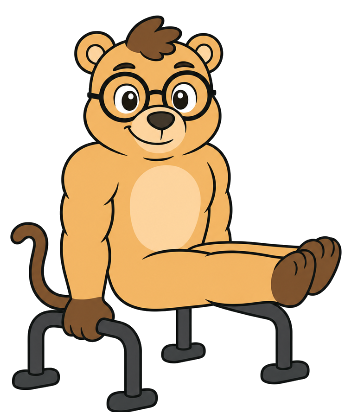
A plank, an L-sit, a lever: holding still against gravity is one of the most effective strength tools there is. One rep is worth about two seconds of a hold, and a shaking thirty beats a solid fifteen at nothing.
Tendons are slower than muscles: the most common way calisthenics goes wrong
Your muscles are ready for the next step weeks before your elbows are, and because the muscles feel fine, you take it. Then something aches for a month. Why the tissue you cannot feel sets the pace, and what to do about it.