Holds are strength work, not a timer game
A plank, an L-sit, a lever: holding still against gravity is one of the most effective strength tools there is. One rep is worth about two seconds of a hold, and a shaking thirty beats a solid fifteen at nothing.
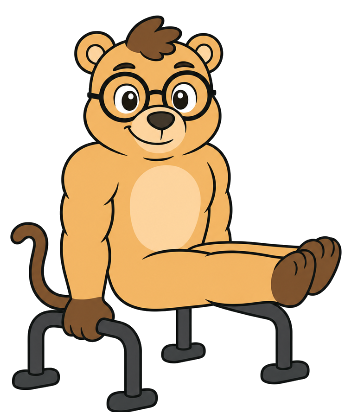
Half of the famous calisthenics skills are not movements at all. The L-sit, the front lever, the back lever, the planche, the handstand: you do not do them, you hold them. That makes holds the most misunderstood tool in bodyweight training, because a clock looks like a goal.
Holding still is strength
Holding a position against gravity asks your muscles to produce force without moving, and they produce a lot of it. Isometric strength runs slightly ahead of moving strength, which is why holds unlock so many skills: the muscle-up gets easier when your support hold is solid, the pull-up gets easier when your hang is solid, and the planche push-up does not exist until the planche does.
Holds also train the position itself. A tuck front lever held for six seconds teaches your lats, your shoulders and your trunk to work together in a line that no amount of rowing teaches. Static work is how the body learns the shape it will later move through.
How Huplito applies it
Hold-based rungs in your plan show a target in seconds, and the voice counts you through them. Log the seconds you held with form, not the seconds you survived. The plan converts them, raises the target a little each session you pass it, and moves you to the next rung when a solid hold reaches the top of the window.
Frequently asked questions
How long should I hold an L-sit?
Long enough to be solid for six seconds, then long enough to reach about fifteen, then move to a harder version. An L-sit you can hold for a minute is an endurance exercise; the straddle L and the V-sit are the next strength steps.
Are holds safe for the elbows and shoulders?
They can be, if you build up to them, because nothing is being bounced. The risk with holds is skipping rungs: a straight-arm hold like the planche lean or the back lever loads tendons that adapt slowly. Own each rung before the next, and stop if a joint hurts.
Should I do holds before or after my reps?
Skill holds, the handstand and the levers, come first while you are fresh. Strength holds like the L-sit sit inside the strength block, paired like any other exercise.
Keep reading
 Foundations · 4 min
When to move to the next calisthenics progression (the three-rep, six-second rule)
The single rule that decides every level in Huplito: you advance when you own the current exercise, with three clean reps or a solid six-second hold. Why six and not three, and why timelines flatter you.
 Foundations · 4 min
Calisthenics rep ranges: why your targets live between 3 and 8
More than twelve reps is endurance. One grinding rep is a technique collapse. Strength lives between three and eight hard reps, a rep or two short of failure, and that window decides when a harder exercise takes over.
 Inside a session · 3 min
The lowering is the exercise: how eccentrics get you your first pull-up
You can lower far more than you can lift. That gap is the most useful thing in calisthenics, because it lets you train a movement before you can do it. Here is how to use it, and why it works.