Why a calisthenics plan still trains your legs (and how far bodyweight leg work goes)
The famous bodyweight skills are all upper body, and plenty of calisthenics plans quietly become upper-body plans. Squat and hinge patterns are half of how your body moves, and they scale from a chair to a pistol.
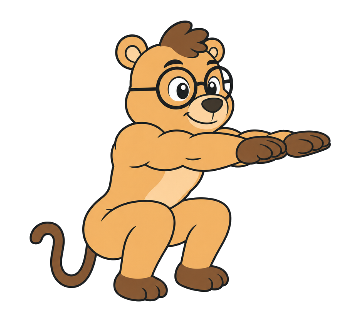
The famous bodyweight skills, the planche, the front lever, the muscle-up, the handstand, are all upper body. So is most of the footage, and so, quietly, are most calisthenics plans: a lot of pushing and pulling, and a token set of squats at the end if there is time. Huplito does not do that, on purpose.
Half of how your body moves
Squatting and hinging, bending at the knees and bending at the hips, are half of your body's movement patterns. Skipping them does not just cost you leg strength. It costs you the hip drive and the trunk stability that the impressive upper-body skills lean on, and it builds the kind of lopsided physique that ages badly: strong arms on a weak base.
It also skips the muscle that matters most for how you feel day to day. Legs and hips carry you up stairs, out of chairs and through the last mile of a walk. Nobody's knees ever thanked them for a bigger chest.
How Huplito applies it
Every session is full-body, and legs are in every session: a squat-pattern movement and a hinge-pattern movement, paired and rested like everything else, climbing their own ladders. If you flag a knee or a hip, the plan routes around it. If you own a chair, you own a leg program.
Frequently asked questions
Can I build big legs with calisthenics?
Strong legs, certainly, and muscular ones: single-leg work at the top of the ladders is as hard as most gym leg work. If maximal size is the goal, weights get there faster; for strength, athleticism and a body that is balanced, the ladders are enough.
How do I progress to a pistol squat?
Through the ladder: deep paused squats, split squats, Bulgarian split squats, skater squats, then assisted pistols holding a doorframe or a band, then pistols to a box, then the full pistol. Most people need the ankle mobility more than the strength, which the paused deep squat builds.
What about running or cycling instead of leg work?
They are good for you and bad substitutes for strength work: both keep the legs in a narrow range under a light load. Keep them, and keep the squat and hinge ladders too.
Keep reading
 Foundations · 3 min
Full body or split? Why a calisthenics plan trains everything, every session
Chest day and back day come from bodybuilding. Below the intermediate levels your limit is a nervous system learning movements, and it learns fastest with three chances a week, not one.
 Foundations · 4 min
Progressive overload in calisthenics: how to get stronger without adding weight
Your body adapts to exactly the demand you place on it. Here is how bodyweight training raises that demand without a single plate, and why the harder version of a movement beats the twentieth rep.
 Inside a session · 3 min
The lowering is the exercise: how eccentrics get you your first pull-up
You can lower far more than you can lift. That gap is the most useful thing in calisthenics, because it lets you train a movement before you can do it. Here is how to use it, and why it works.